听力整体难度:较难Part 1为填空题,话题常规,难度一般;Part 2地图题+双选,对于细节抓去以及听取同义替换的反应速度要求较高。Part 3为新题,话题为coral reef 是常考的生物环境类场景;Part 4 为常规填空题,也是高频生物环境场景。
Part1演唱会买门票
【题型】:填空+表格
【场景】:活动咨询
【难度】:一般
点评
本场Part 1是本周新航道考情预览里面命中的以及准备话题“艺术节活动”,大家记得每周关注我们的预览;答案词如parking,cinema也都是part 1 常考的高频答案词,整体很好预判,难度一般,大家平时一定要多多强化场景词的复习与听写。本次Part 1 出现了地名Scotland,提醒大家注意积累有名的国家和地区名字以及其拼写。1.012725826742.Agency3.Square4.5.305.main6.busy7.cinema8.Scotland9.directors10.parking
(答案仅供参考,实际答案及顺序可能有变化)
Part2体育馆改造
【题型】:地图+双选
【场景】:场馆介绍
【难度】:较难
点评
本次part 2题目场景是常考的景点场所介绍,题型为地图题+双选题;地图题要注意跟好行进指令,双选题干扰较多,同学们在听的时候要注意关注细节。双选题:11-12. Shop and childcare center are closed for part of the day.C E13-14. Changing rooms and the weight room have been updated recently.A C
地图题15-20:
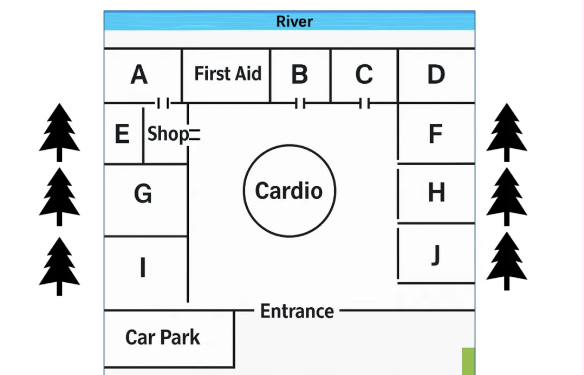
(答案仅供参考,实际答案及顺序可能有变化)
Part3Coral reefs
【题型】:单选+多选
【场景】: 课题讨论
【难度】:较难
点评
Part 3长选项选择题对同学们的审题速度和听音过程中的理解速度要求都较高!大家一定要找准定位词,跟好节奏,并且强化审题时确认听音重点的能力,听音时可以借助笔记。21.B agree to start with data and graphs?22.A disagree about whether sunscreen is harmful?23.C need more information about whether large container ships are harmful to water quality.?24.B?25.C provide a summary, not the ideas.?26.A end the presentation with tips for people to protect coral reefs.?27-28: B E29-30: A C
(答案仅供参考,实际答案及顺序可能有变化)
Part4 秘鲁燕鸥(Peruvian Tern)
【题型】:填空
【场景】:生物环境
【难度】:正常
点评
本场考试Part 4题目,从题型来说是常考的生物环境场景,也是本周考情预览中提醒同学一级准备的场景;答案词大部分都比较常规,需要注意的是copper n 铜 这一类的化学物质累单词在近两个月已经多次考察到,大家一定要注意积累此类场景词。31. Mostly in Peru from December to?April32. colour33. call34. gap35. lost habitat due to?tourism36. copper37. plastic38. dogs39. airport40. special?reserves?to protect them.?
(答案仅供参考,实际答案及顺序可能有变化)
9月的风吹散了暑假的燥热,也吹走了8月雅思阅读的“阴间难度”!本次阅读堪称“友好三连击”: ?首篇《网球起源》优雅挥拍——文艺复兴贵族运动史搭配清晰的时间轴,定位有救了; ?第二篇《新西兰考试性别差》温柔放送——宛如老师们的深夜吐槽:“为什么男生总不肯好好写作文?”,悄悄告诉你核心秘密——原来男孩女孩的差异,最后都怪“写字太少”; ?终篇《Sir Francis Ronalds》真诚致敬——标题看似人畜无害的科学家传记,实则细读之下,其开创性工作足以让人惊叹“脑细胞不够用”。难度评级:知识广度★★★★☆ 脑力消耗★★★★★
Passage 1网球起源 The origins of Tennis
【题型】:判断题*6+填空题*7
【类别】:发展史类
【难度】:★★★
判断题1.FALSE2. TRUE3. NOT GIVEN4. FALSE5. TRUE6. NOT GIVEN
填空题7. surfaces8. net9. rubber10. rules11. equipment12. shape13. tournament
(答案仅供参考,实际答案及顺序可能有变化)
点评
看到标题“网球起源”时嘴角疯狂上扬——体育题材!稳了!读了两段后瞳孔地震:这哪是网球?分明是《欧洲王室谱系大全》!雅思你又一次让我意识到,我的英语水平和历史知识储备在表演“皇帝的新装”......发展史类文章实在再熟悉不过了,从中国的古代战车、巧克力发展史、玻璃制造演变,到现在的网球起源——雅思命题组的P1唯爱“人类文明发展史”这件事已经藏不住了!(类似话题请自觉复习剑19-T1-P1 How tennis rackets have changed,别怪我没提醒你!)
Passage 2新西兰高中考试结果性别差别The gender gap in New Zealand’s high school examination results
【题型】:填空题*3+段落信息匹配题*4+特殊词匹配题*6
【类别】: 实验研究类难度:★★★★
填空题14. Pass rates15. decade16. Australia
段落信息匹配题17. C18. B19. D20. E
特殊词匹配题21. H22. E23. G24. C25. F26. B
(答案仅供参考,实际答案及顺序可能有变化)
点评
开篇就抛出惊天数据:女生全科碾压男生10个百分点,成绩单仿佛自带警报器;文末彩蛋:研究最后发现男生17岁逆袭的秘密——“有现金奖励时竞争本能瞬间激活”,建议也给烤鸭们发阅读满分红包。话题又是实验研究类,很多同学一看到就头疼,认真看又是看不懂,秘诀在于:实验背景、过程打包起来看,实验结论重点看。相关类型请参考剑12-T7-P3 Music and the emotions、剑13-T1-P2 Why being bored is stimulating、剑15-T2-P3 Having a laugh等。新西兰教育类考题真是雅思常客:剑5-T3-P1 Early Childhood Education、剑9-T2-P1 The Impact of Hearing Loss on Young Children申请出战,温馨提示:下次看到新西兰教育题材请高呼——又是你!我们已经看透性别差异+族群对比+政策分析的套路三连啦!
Results from New Zealand's new national examinations for secondary schools are giving that country some cause for concern.
A. The issue is the difference in pass rates between the sexes: at each level of the examination and across all school types, the difference is about 10 percentage points. Girls are doing better in every subject, and those in girls-only schools are taking top honors. The results are not a surprise: high school girls have been outperforming boys academically for more than a decade. It is an international phenomenon, and within Australia, it was the subject of much debate and controversy. Within New Zealand back in the 1980s, there was a concerted campaign, called "Girls Can Do Anything," which was aimed at lifting girls' participation rates, achievement levels, and aspirations. This was so successful that the pendulum has now swung to the other extreme. Views differ on how worried people should be. After all, for much of history, girls were excluded from any form of education, and this new phenomenon could be seen as a temporary over-correction before the balance is righted.
B. However, the New Zealand State Ministry of Education says it is taking the issue seriously. It is working with a reference group on boys' education, which has been set up, and it has commissioned an Australian academic to report on interventions that have been found to work for boys, drawing particularly on Australia's experience. But some, such as former prison manager Celia Lashlie, the author of a book for parents of teenage boys, believe there is still resistance within the Education Ministry towards doing anything about the problem
C. Education Ministry learning policy manager Steve Benson says that the National Certificate in Educational Achievement, or NCEA, as New Zealand's high school exams are called, is useful to employers and to universities because it provides a fine-grained picture of pupils' performance in every aspect of a subject, rather than just a pass or fail in an overall area. In most parts of the curriculum, for example in maths, there isn't really a gender gap. But literacy is a different matter. Even boys who are good at writing tend not to write so much. There's actually a quantity issue.
D. The discrepancy in reading and writing skills between males and females shows up as early as preschool, and the most significant difference is clear by the time these children enter high school. Not being good at literacy was not such a problem in the old days when many students left school for manual jobs after Year 11. But nowadays, many more stay on to higher education, and almost all jobs require literacy skills. Roger Moses, the headmaster of Wellington College, says that the written content of NCEA papers is more demanding than the previous system of secondary school qualifications in New Zealand, even in subjects such as statistics and accounting.
E. New Zealand 15-year-olds do better in international reading tests, but beneath this average lies a wide variance, with New Zealand European girls most represented at the top and New Zealand Pacific Island boys at the bottom. Yet some European girls drop out, and some Pacific Island boys excel. In other words, the range in performance within each gender group is much greater than the gender differences. Ethnic differences, and differences in socio-economic status, may be more significant than the simple boy/girl explanation.
F. This makes the Education Ministry nervous about pushing solutions that emphasize stereotyped gender differences, rather than looking at underachievement as a whole. Rob Burroughs, principal of Linwood High School in Christchurch, agrees. For three years, his school ran separate boys' classes to try to address the disparity in performance, before abandoning them. The research showed that the boys did better in their own class than in the co-educational environment. But when he looked at which teachers they had, and how well those teachers' other classes did, it became clear that the difference was, instead, to do with the quality of instruction.
G. At Onslow College, Dr. Stuart Martin would do away with the NCEA Level 1 exam if he could. He says that in Year 11, aged 15, boys are simply not mature enough to cope. They tend to think that just passing is enough, and that it's not necessary to work hard for a Merit or an Excellence grade. Often they are busy with other activities and part-time jobs. Boys' competitive instinct tends to come out later in their schooling years, especially if there is money attached or other tangible rewards. By 17, boys are catching up academically with the girls, and by the end of Year 13, boys are again winning the top prizes.
Passage 3 Sir Francis Ronalds 弗朗西斯·罗纳德爵士
【题型】:段落信息匹配题*4+填空题*5+特殊词匹配题*5
【类别】:科普类
【难度】:★★★★
段落信息匹配题27. A28. H29. E30. B
填空题31. 1861 official recognition31. letters and numbers32. glass tubes33. 800km34. frictional electricity
特殊词匹配题36. G37. E38. C39. A40. F
(答案仅供参考,实际答案及顺序可能有变化)
点评
第三篇《Sir Francis Ronalds》宛如收到一封来自19世纪的科学情书——标题看着是温柔传记,打开竟是电磁学论文精选集。细细读下来,感觉像是雅思命题组端出的“秋天的第一杯奶茶”,意外顺滑,喝完还想续杯!所以,当下次瞬间收到千里之外的信息时,不妨记得弗朗西斯·罗纳德这个名字——一位在花园里架起八英里电线、却只换来一句“不需要”的孤独先知。他的故事告诉我们:最伟大的灵感,有时只是源于一份纯粹的好奇与坚持,而非时代的理解。烤鸭们的雅思征程何尝不是如此呢,总有一天会对得起你熬过的日夜~
A. RONALDS, Sir FRANCIS (1788-1873), inventor of the electric telegraph and meteorologist, son of Francis Ronalds, a London merchant, and of his wife, Jane, daughter of William Field, was born in London on 21 Feb. 1788. Ronalds was educated at a private school at Cheshunt by the Rev. E. Cogan. At an early age he displayed a taste for experiment, and he acquired great skill later in practical mechanics and draughtsman ship. Under the influence of Jean Andre de Luc (1727- 1817), whose acquaintance he made in 1814, he began to devote himself to practical electricity. In 1814 and 1815 he published several papers on electricity in Tilloch’s 'Philosophical Magazine,' one of which records an ingenious use of De Luc's 'electric column' as a motive power for a clock.
B. Ronalds's name is chiefly remembered as the inventor of an electric telegraph. Since 1753, when the first proposal for an electric telegraph worked by statical electricity was made by a writer signing 'C. ' (said to be Charles Morrison) in the 'Scots Magazine', successive advances had been made abroad by Volta, Le Sage, Lomond, Cavallo, Salva, and others; but much was needed to perfect the invention.
C. In 1816 Francis Ronalds, then living at Upper Mall, Hammersmith, built in his back garden two frames to accommodate eight miles of wire for his new invention of an electrostatic telegraph. It used clockwork-driven rotating dials, engraved with letters of the alphabet and numbers, synchronized with each other, at both ends of the circuit. For the past three or four years, encouraged by the octogenarian Swiss meteorologist, Jean Andre De Luc, Ronalds had been enthusiastically experimenting with electrostatic clockwork devices. When someone desired to send a message he earthed the wire at his end at the moment when the dial indicated the desired letter. At the receiving end the pith balls would fall together when earthed and the recipient noted the letter showing on his dial at that moment. The system was slow and depended on the two dials staying in step, but Ronalds successfully transmitted and received letters over 150 meters of wire ; later he succeeded in sending messages through eight miles of iron wire suspended above his garden in London.
D. After sending messages along his wires on the frame, he developed another version in which the wires were enclosed in glass tubes buried in the ground. At each end of the line a clockwork mechanism turned synchronously revolving discs with letters on them. A frictional-electricity machine kept the wire continuously charged, while at each end two pith balls hung from the wire on silk threads, and since they were similarly charged from the wire they stayed apart. Ronalds 'S instrument was of real practical use, and the brilliant idea of using synchronously rotating discs, now employed in the Hughes printing apparatus, was entirely his own. The only defect in his invention was the comparative slowness with which a succession of symbols could be transmitted.
E. With communications between London and Portsmouth in mind, he believed his telegraph would work over distances of 800km. In the same year, Ronalds wrote to offer his invention to the Admiralty. In fact, in 1806, Ralph Wedgwood submitted a telegraph based on frictional electricity to the Admiralty, but was told that the semaphore was sufficient for the country. In a pamphlet he suggested the establishment of a telegraph system with public offices in different centers. Francis Ronalds, in 1816, brought a similar telegraph of his invention to the notice of the Admiralty, and was politely informed that 'telegraphs of any kind are now wholly unnecessary.' John Barrow, Secretary to the Admiralty, replied that "Telegraphs of any kind are now wholly unnecessary; and no other than the one now in use will be adopted." (The one in use was a semaphore system. Only a year after the end of the Napoleonic Wars, the Admiralty saw no need for improved communications, even though the semaphore was usable only in daylight and good weather.
F. After this disappointment, Ronalds set off for the continent. He travelled throughout Europe and the Eastern Mediterranean, taking notes, sketching and collecting scientific books between 1816 and 1823. He had begun collecting his large library of works on electricity and kindred subjects. The last activity formed the beginnings of the Ronalds Library, left in trust to the IEE (now the IET) after his death. In a small pamphlet published in 1823, Ronalds described his invention and listed some of its possible uses, "Why should not government govern at Portsmouth almost as promptly as in Downing Street? Why should our defaulters escape by default of our foggy climate? Let US have Electrical Conversazione offices communicating with each other all over the kingdom if we can." In 1825 he invented and patented a perspective tracing instrument, intended to facilitate drawing from nature, which he improved about 1828, and described in a work called 'Mechanical Perspective.' These instruments seem to be the only ones for which he took out patents.
G. However, Ronalds never patented his invention in electric telegraph. Ronalds seems to have made few or no practical contributions to science. In the meanwhile, one person did benefit from this work-Charles Wheatstone who saw the telegraph as a boy. When Charles Wheatstone was quite a child, his father had seen the Ronalds telegraph at work. Later, the invention of an electric telegraph had been marvelously developed by Wheatstone, who had seen many of the Hammersmith experiments, in conjunction with Mr. William Fothergill Cooke, and these two men together devised and patented in 1837 the first electric telegraph used publicly and commercially in England. When, in 1855, a controversy arose between Wheatstone and Cooke with regard to their respective shares in the invention, Wheatstone at once acknowledged his direct debt to Ronalds, and Cooke, though less fully, acknowledged the priority of Ronalds's work; Until 1855 Ronalds's share in the invention had been forgotten by the public.
H. Early in 1843 Ronalds was made honorary director and superintendent of the Meteorological Observatory, which was then established at Kew by the British Association for the Advancement of Science. He began work on a system for registering meteorological data using photography and this time was awarded a grant to continue his work. A similar system was developed independently by Charles Brooke, aided like Ronalds by grants from the Royal Society, had invented independently about this time. But the British Association confirmed Ronalds's priority. This was the beginning of automatic, accurate recording of meteorological data and remained in use for some years after Ronalds's death.
I. Ronalds lived long enough to see his prophecies come to fruition and to receive belated official recognition: in 1870, three years before he died, he was knighted by Queen Elizabeth I, for his "early and remarkable labors in telegraphic investigations."
小作文
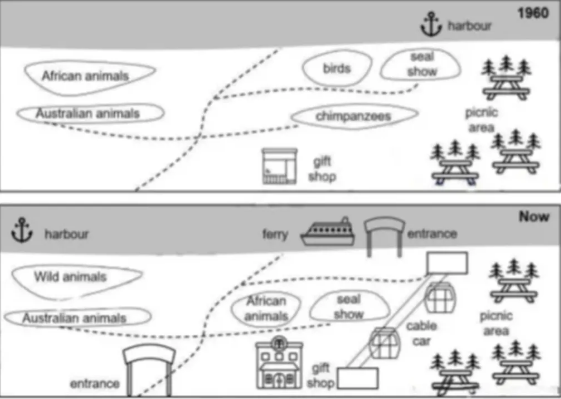
The map below shows the changes that have taken place at a zoo in Australia between 1960 and now.Summarise the information by selecting and reporting the main features, and make comparisons where relevant.
点评
本次考试小作文考查的是地图题,写作时需要关注到题干上的时间信息,整体难度适中。
写作思路:主体段一可以对第一张地图上信息进行描述。可以先从北部的harbour开始,描述西北角的African 和 Australian animals的区域,随后过渡到对面的birds, seal show, chimpanzee的区域,并突出各个区域有小路衔接。之后可以描写南部中间的gift shop, 最后描写位于动物园东部区域的picnic area.
主体段二需要突出变化的部分,并按照前一段的描述顺序依次呈现出变化。北部区域如今增加了停泊ferry的区域,且多了一个entrance,而原有的harbor搬迁到了西北角。西北部分原有的African animals变为了wild animals区域,在其对面的birds, chimpanzee区域都拆除了,而seal show的位置下移了。 在现在的seal show区域西边增加了African animals 区域,而东边新建了cable car。Gift shop也翻新了,且左边多了一个entrance。园中的道路和picnic area未发生改变。
大作文
Although modern technology has made international communication very easy, many businesses people still travel long distances for business meetings. Do the benefits of face-to-face meetings outweigh the disadvantages?
点评
本次大作文部分考查的是常规辩论类题型(利弊分析),需要考生们讨论“线上会议是利多还是弊多”的问题,整体难度适中。写作的结构上面可以采取常规的主体段一写立论段,主体段二写驳论段,并对反方观点进行反驳的框架,或者选择在主体段一中先呈现出反方点子,再在主体段二中呈现出正方点子的框架。
写作思路:线上会议的优势:1. 更加具有灵活性,参与者可以跨越地理界线,随时随地进行线上会议,免去通勤路上的时间和精力的成本消耗,实现更加及时和高效的信息交流,达到更好的会议效果。2. 线上会议对环境更加友好,因为减少了远程通勤的次数,尤其是减少长途航班的需要,整体来看会减少碳排放,有助于缓解因碳排放而造成的气候变暖、海平面上升等环境问题。3. 一定程度上减少花销,因为线下会议会包含交通,食宿等难以避免的消费。
线下会议的优势:1. 线下会议能帮助参与者们更好的建立相互了解和相互信任。因为相比于线上交流,线下会议意味着参会人员能有直接接触,比如握手、一起吃饭等,有助于建立起长期的合作关系。2. 参与线下会议能够更加高效地完成任务。线上会议中总会遇到如网络不稳定等问题,影响会议的流畅度,且可能参会人员难以精准的表达自己的意思,从而造成误解
【责任编辑】:长沙新航道小编 版权所有:转载请注明出处
如本网转载稿、资料分享涉及版权等问题,请作者见稿后速与新航道长沙学校联系,我们会第一时间删除.